In general, dispensing can be defined as transfer of fluid from a container (typically in syringe) to a substrate in a form of pattern or calculated volumes to host a die or component. In electronics industry, there are various methods that have evolved to keep up with the rapid development of manufacturing need for adhesives and conductive epoxies in a wide array of packaging assemblies.
Over the years, dispensing applications have expanded to other areas needed for new types of packaging encapsulation techniques. A wide variety of fluid materials with different viscosity are being used, from solder paste, conductive adhesives and damming compound to fluxes, thermal paste and underfills.
Epoxy Dispensing Tools ......................................EDT
Common Dispensing Nozzle .............................. CDN
Micro Dispensing Nozzle .................................... MDN
MDN Luer Lock ...................................................MDN
Luer Dispensing Nozzle ..................................... LDN
Epoxy Dispensing Nozzle ................................... EDN
Rubber Epoxy Stamping Tools ........................... REST
Steel Epoxy Stamping Tools ............................... SEST
DISPENSING PROCESS AND TECHNOLOGY
Stamping:
Sometimes known as daubing or pin transfer, this method involves dipping a compliant tool into a reservoir of liquid material then transferring the adhering liquid onto a substrate. This method is frequently used to attain very small dots. However, the process is considered slow as compared to other methods especially if the application requires multiple dots dispensing. To increase throughput, gang (multiple) stamping tool can be employed to stamp an array of dots simultaneously. Grid type stamping tool is also available to print a large area.
Stencil Printing:
Stencil printing is the fastest and most efficient way of applying adhesive to a large area in mass production runs. In this method, a patterned stencil is placed over the substrate and a squeegee force the material through the stencil apertures onto the substrate. This may become complicated when the stencil apertures become so small that the material can no longer print effectively.
Jet-dispensing:
Non-contact jet-dispensing is one of the newer methods in dispensing technologies. Shots of fluid are fired onto the substrate in a non-contact process. Since dispensing dots are typically restricted to one specific size during a run, larger volumes are achieved by accumulating multiple dots. By moving the jet head during deposition, required patterns can be formed.
Nozzle or Needle Dispensing:
In this method, time and air pressure is commonly used to push the fluid through a needle or nozzle to form single dot or multiple dot patterns over the substrate. Over the years, various dispensing platforms with programmable pumps and valves, such as auger and piston have been developed to achieve unique patterns or volumes using single needle or special tapered nozzle. These platforms could either be stand-alone dispensing equipment or integrated on those new pick and place machines.

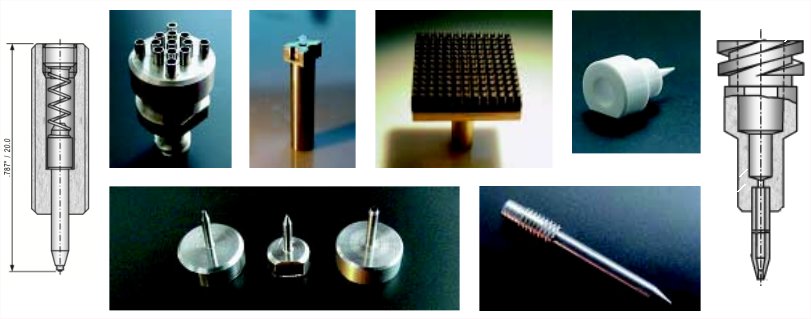
 EPOXY DISPENSING TOOLS
 COMMON DISPENSING NOZZLES
 MICRO DISPENSING NOZZLES
 DISPENSING EQUIPMENT
 LUER DISPENSING NOZZLES
 EPOXY DISPENSING NOZZLE
 RUBBER EPOXY STAMPING TOOLS
 STEEL EPOXY STAMPING TOOLS